Kid’s Corner
Visit our kid-friendly pages for all ages!
Q&A
Find answers to some commonly asked questions about planting, pruning and maintaining the trees on your street or in your yard.
How do I get a tree planted in front of my house?
Thank you for wanting to add beauty and cooling shade to your neighborhood with a new street tree! The City plants street trees in the Spring and in the Fall. To get on the waiting list, download a New Tree Request form today from the Tree Warden's website.I want to plant some flowers around my street tree. Does it hurt a street tree to plant flowers in the soil around it? What about adding mulch?
Annual flowers are a lovely addition around a street tree, and watering them waters the tree too! But perennial plants are not a good idea near a street tree — their extensive root systems will compete with the tree for nutrients and water. Grass is also not recommended, especially since trunk damage from string trimmers and other mowing equipment is a major killer of young trees.
The City mulches newly planted trees to help retain moisture and fight competing weeds, and to keep mowing tools from damaging the trunk. If the mulch looks thin, please do renew it! Keep in mind though that “mulch volcanoes” kill trees. Using organic mulch only, apply a donut-shaped layer 2”-4" thick around the tree, leaving a 3” gap between mulch and trunk.
What should I do to keep the shade tree in my yard safe and healthy?
- Especially in times of drought, check to see if the soil around your tree is dry 4 inches below the surface. If it is, water your tree deeply. A long, slow trickle from a hose does this well. Soil moisture is especially critical for young trees.
- Protect the tree’s root system from damage.
- Have your tree inspected and, if necessary, pruned by a Certified Arborist once every 2-3 years, and any time you think it has suffered damage. Certified Arborists are required to stay up to date on best arboricultural practices for tree safety and disease prevention, and know how to prune a tree for healthy growth.
What is the best way to care for a street tree?
- And also excellent tips for plantings of any kind in the planting strip.
When is the best time to prune a tree?
Who do I call if a street tree needs to be pruned for safety?
Please do not fertilize or prune a street tree. If you have concerns about tree health, contact the Tree Warden. Improper pruning or overfertilization can harm or kill the tree.
How do I get a dead street tree removed?
Contact Watertown Urban ForestryWhat can I do to help trees during times of drought? Read more…
What can I do to prevent the weight of snow and ice from breaking my tree's branches?
If you notice snow build-up on a tree during a snowstorm, shake the snow off the branches as high as you can reach, and keep the branches as clear of ice and snow as you can. A painter's pole is light and easy to handle, and can extend your effective snow removal range.Can I get asphalt removed from the street planting strip?
Contact Watertown Urban Forestry
Urban Forestry Division
Watertown Tree Program annual and long-term objectives (report, 2019)
Our blog and other articles of interest
Ten Major Values of Trees
What a large urban street tree can do for you22 Benefits of Urban Street Trees
An illustrated brochure by Dan Burden, Senior Urban Designer. Glatting Jackson and Walkable Communities, Inc; May, 2006Watertown Tab & Press:
Part I What's So Bad About Leaf Blowers?
Part II What's So Bad About "Mulch Volcanoes"?
Part III What's So Great About a Shade Tree?The Successful Tree Planting Initiative A series of articles from the Massachusetts Urban & Community Forestry Program detailing how to improve urban shade tree survival.
Part I Conducting a Site Assessment
Part II Tree Selection
Part III Tree EstablishmentWhat is a Tree Worth
Moderate public discussion sponsored by Trees for Watertown
CLICK HERE YouTube meeting video
CLICK HERE Download a one-page description of the event
CLICK HERE Download the slidesAsian Long-Horned Beetle flyer
The Right Tree for Me: presentation about tree-centric landscaping
Other Resources
i-Tree Tools for Assessing and Managing
Community Forests
Visit this website to calculate the value of your neighborhood trees!
Trees are Good.org
ISA website created to help educate the public about the importance and value of proper tree care. Lots of good materials.



Massachusetts DCR
Urban and Community Forestry Program
Go to this website and subscribe to the monthly Citizen Forester! It's free!
Urban Forestry Today
A terrific series of informative one-hour webcasts.

Planting around a street tree
Street trees will probably do OK with flowers planted around them, as long as the tree roots are protected during planting and the new plants don't out-compete the feeder roots of the tree for water, soil oxygen, and nutrients. Some plants to be avoided because of their dense root systems include ferns, hosta, day lilies and grasses.
As you plant your flowers in the root zone of a tree, take some precautions to protect the tree roots. Roots larger than about an inch diameter help stabilize a tree. Take care not to damage or cut these; instead carefully plant around them.
You may find a dense network of fine feeder roots in the area where you want to plant. These tiny roots are the ones that take up nutrients and water from the soil. This function is vitally important to the tree, so it is important not to remove any more than is necessary to make space for each flowering plant.
If you find feeder roots obstructing the hole you're digging for a new plant, be sure to trim them back cleanly rather than tear them out. Clean cuts are easier for the tree to recover from quickly, which helps minimize the possibility of fungus infection. Water the area thoroughly, both right after you've planted your flowers and anytime the root area seems dry. Good for the flowers AND the tree!
When is the best time to prune a tree?
Removal of dying, diseased, broken, rubbing, or dead limbs can be done anytime during the year. Removing dead and damaged tissue can help limit further damage.
However live-branch pruning is best done when the tree is dormant, in the winter or before growth resumes in early spring. Growth is maximized, and defects are easier to see. Pruning when trees are dormant can minimize the risk of attack from parasites and diseases associated with wounding and allow trees to take advantage of the full growing season to close and compartmentalize wounds. Dormant pruning is especially important for elms and oaks.
Avoid pruning trees during or soon after flowers and leaves appear in the spring. This is when the cambium is active and bark is particularly vulnerable to being torn loose. Avoid pruning in summer too, when trees are still in active growth and may be stressed by drought. This is especially true for a tree that is already stressed by a limited root area or poor quality soil.
Another important consideration is nesting birds! The majority of songbird nests are small and camouflaged. Tree trimmers may not see nests until too late. Also, loud activity of tree trimming can disturb birds in surrounding trees.
Birds and active nests are protected from harm or harassment by the Migratory Bird Treaty Act. The Audubon Society advises that if you see tree trimmers disturbing an active nest, TAKE A PICTURE of the nest, the destruction, and the company's name. Report violations to the Law Enforcement Office of U.S. Fish & Wildlife Service at (310) 328-1516 (Office of Investigations and Compliance Inspection). The U.S. Fish and Wildlife Service will issue citations and may levy fines to individuals and companies that blatantly disregard the regulations.
Five easy things you can do to help care for our street trees all year long.
Finger-prune new trunk sprouts when you see them
Trees sometimes send out new leafy growth directly from the trunk. These sprouts take energy from the tree that the tree instead could be investing in healthy top growth. If the sprouts are allowed to grow they will eventually get in pedestrians' way and may be torn off, rather than cleanly removed. Torn breaks are routes for infection into a tree.
Trunk sprouts can easily be removed by hand while they are still young and tender. The older they are, the more difficult they will be to remove cleanly without a sharp tool. So help a street tree by snapping off new trunk sprouts cleanly with your fingers when you see them.
Pull up grass and weeds growing around a tree, and mulch the tree site
Weed-whackers are one of the most common reasons for tree death. The string beating against a tree's trunk at high velocity crushes circulatory channels lying just beneath the bark. Young trees are most vulnerable, but even mature trees can eventually be killed. Keeping the area around a tree weed- and grass-free reduces the likelihood of a weed-whacker getting close enough to the tree to do damage. It also reduces competition for water and nutrients.
You probably know mulching is important for plant health, because it helps keep the soil moist and reduces weed competition. But did you know that piling too much mulch around a tree can actually kill the tree?
Don't store heavy things on the planting strip (and don't park your car there!)
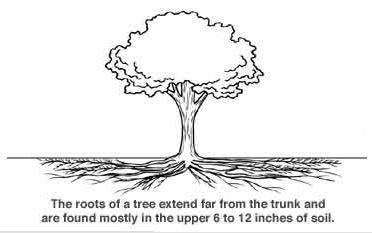
Did you know that tree roots need oxygen? Both water and oxygen uptake from the soil are vital for tree health. Roots need a soil structure full of tiny holes containing both water and air in order to absorb those nutrients. Parking on the planting strip compresses the soil so that it can no longer hold water and air and kills the feeder roots, which live only in the top few inches of the soil. Same goes for leaving heavy construction materials on the planting strip.
Water the street tree in front of your house when it's dry
Many people think a tree's roots go very deep. Structural roots, the roots that hold a tree secure in a windstorm, can extend a few feet down. But a tree's feeder roots, which is how the tree absorbs nutrients from the soil, are only in the top few inches of soil, and can extend far from the trunk. If the soil around a tree dries out, so do the feeder roots.Young trees need regular thorough watering to establish good root systems.
Mature street trees too will benefit from regular thorough watering in a drought. The soil around them is often partially covered by hardscape or is of poor quality for holding water. If you want to help a mature tree in a drought, water its full root area thoroughly, once a week, at least as far out as the farthest branches extend.
Download a copy of the Tree Warden's guidelines for tree planting care (pdf) from the Tree Warden's website
Let the Tree Warden know ASAP if you see a damaged or dead street tree
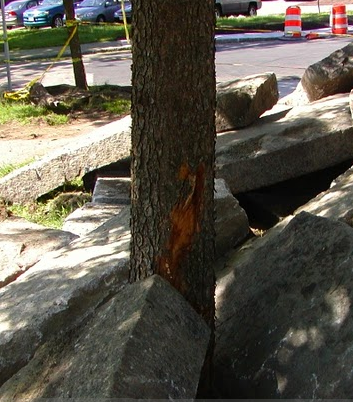
Please contact the Tree Warden ASAP if you see damage to a street tree! Prompt first aid by a knowledgeable arborist will minimize the routes for infection and help prolong the life of the tree. And a very badly damaged tree may be a hazard to public safety.
If you see street tree damage in process, please call the Tree Warden AND the Watertown Police. This is destruction of public property, and the perpetrator must recompense the Town. In the case of car impact, the car owner's auto insurance will pay for the damage, but only if the police can file a report identifying the driver. Recompense for destruction of a public shade tree is calculated using a formula based on the diameter of the tree.
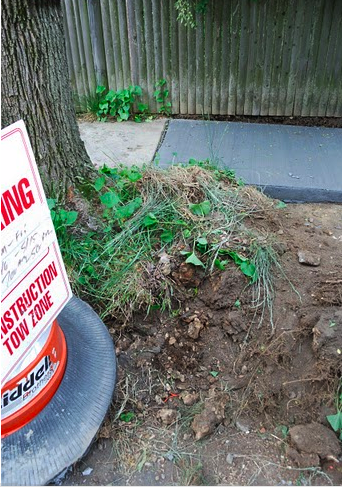
Street and sidewalk renovation is hard on street trees. Watertown's contracts include procedures for tree protection, but sometimes those procedures are not followed. Please contact the Tree Warden as soon as you see tree problems at a street renovation, so that he can remediate the damage and make sure contractors understand their responsibilities to protect Watertown's street trees.
Please immediately report a dead tree to the Tree Warden. Quick notification can save the town money, and the sooner a dead tree is removed, the sooner a healthy new tree can be planted in the same site.
When a branch is broken or bark is damaged, a tree will try to heal itself, but if the damage is left untended, good healing may be impossible. Much as bacteria will find entry into our body via a dirty cut, insects and fungi will use a jagged wound to infect a tree. Energy a tree must put into isolating the wounded part is energy it can't spend on healthy growth.
Torn or dried-out roots can also cause serious injury to a tree, by limiting its ability to absorb soil nutrients or as an entrance point for infection. Until professional help comes, it can be helpful to cover exposed and damaged roots with wet burlap or another moist covering (make sure it stays wet). Unfortunately for our trees, if reburied without first aid, root damage can continue to degrade the health of a tree. The damage is insidious: it can take years for a healthy mature tree to decline due to root damage. Commonly, at that point the cause of the decline is long forgotten and there may be little that can be done to help the tree recover.