
Check out this excellent webinar posted just recently on Youtube by Wildr Places.
From Extinction to Action -- What Deep Time Can Teach Us About a Wilder Future
https://www.youtube.com/watch?v=e0Gy-QAvEZk
Sixty-six million years ago, an asteroid changed life on Earth forever. Today, we're facing another biodiversity crisis, but this time, we have the power to change what happens next.
Join paleontologist Dr. Kenneth Lacovara (starts at 7 min) and ecologist Dr. Doug Tallamy (starts at 34 min) for two thought-provoking talks on extinction, the future of biodiversity, and why restoring nature where we live matters more than ever.
The message? Hope is good. Action is even better.
The US needs stronger controls on imported wood products that bring in invasives. Notoriously, it was wood shipping pallets from Asia that brought Asian Longhorn Beetle to Worcester County about 20 years ago. However, DCR has finally been able to certify a couple Central Mass. towns ALB-free (Holden and Shrewsbury). There’s also good news in the evidence that some invasive bugs can be naturally controlled, without introducing a non-native predator that could itself become invasive. For instance some native critters seem to be developing a taste for Spotted Lantern Fly. And as the article mentions, identifying and protecting individual trees which exhibit natural resistance to an invasive scourge eventually allows a tree species to come back.
Nature Communications volume 17, Article number: 2408 (2026)
Urban forestry for cooler cities faces three critical hurdles
Thami Croeser, Mohammad A. Rahman, Arnab K. Ghosh
Summary
While canopy cover close to buildings is a vital tool for urban heat adaptation, it remains inadequate in commonly used urban designs. This is the case even in cities with relatively high overall canopy cover. Upscaling urban tree planting programs will be important in responding to this problem. However, to do so meaningfully today and into the future, cities must plant large numbers of trees in a way that: (1) Achieve sufficient density to provide meaningful shade in streets; (2) Ensure adequate soil volume, water infiltration, and appropriate species selection for healthy growth; and (3) Ensure these trees grow to maturity over their decades-long life course. We currently possess the means to achieve these outcomes; an array of governance tools (e.g. building and civil design codes, zoning provisions, tree protection ordinances and urban forestry implementation plans) is available or can be modified to achieve what is required.
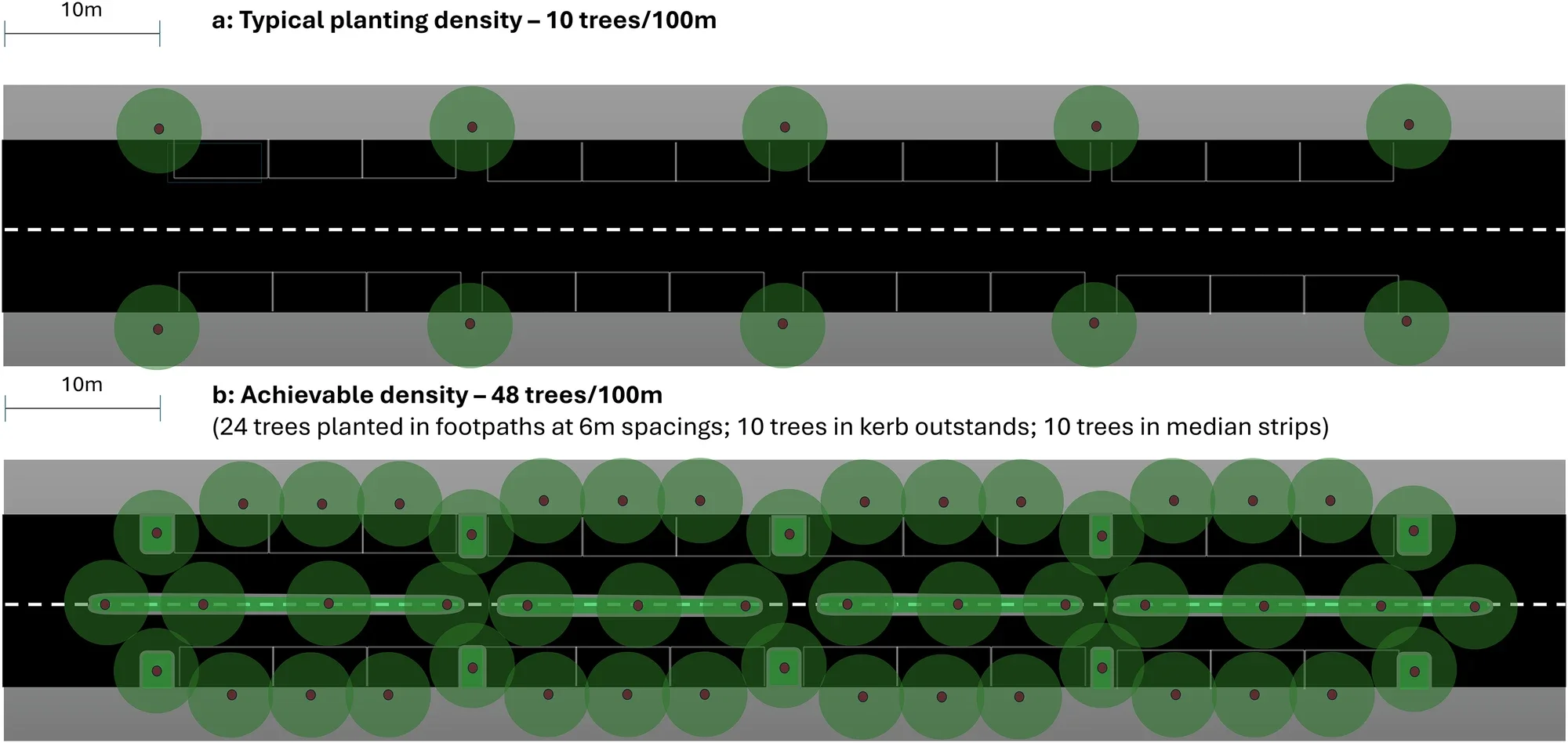
Urban trees can protect city residents from extreme heat, but tree planting programs seldom provide sufficient shade where it is most needed. We synthesize evidence highlighting three rarely fulfilled prerequisites for the effective use of trees in heat adaptation.
Practitioners directly responsible for canopy expansion are generally well-aware of these vital prerequisites to success. However, without governance reforms, they cannot act effectively on these frontiers28. Reforms to improve achievement in these areas will require careful engagement with communities, financing structures, institutions and legislation, led thoughtfully by executive and political leaders who understand the long-term potential of urban forestry.Improving achievement in the areas we have outlined is not just a matter of changing planting designs or tree protection rules. The value of the urban forest as a truly heat adaptive measure relies upon overcoming the barriers of inadequate capital and maintenance budgets, organisational silos, obstructive regulations, obsolete design practices, and disengaged local communities.
While the social benefits of urban trees are not limited only to heat mitigation (e.g., improved social capital, improved safety, and increased mental health benefits), as heat waves grow in intensity, frequency, and severity, we see enormous promise for cities in countries at varying levels of economic capacity to successfully tackle this nexus of barriers and deliver dense, shady plantings of healthy, long-lived trees for their communities and their climate resilience.
New York Times Climate Section 8/18/26
Saving old trees might save lives
By Alexander Nazaryan
When it comes to urban trees, old is gold.
Many cities across the country, including New York, have been planting trees in neighborhoods where cooling shade has been sparse because of neglect in decades past. But a new study has found that simply adding trees is not enough: To get the most from tree cover, communities also have to preserve older ones.
“If we take care of trees, they take care of us, and might even help save our lives,” said Harrison C. Garcia, a student at the Northwestern University Feinberg School of Medicine and the lead author on the study. “They’re not just a luxury. They’re not just something to look at.”
For their research, published this month in the journal GeoHealth, Mr. Garcia and his co-authors used satellite maps from the U.S. Forest Service National Land Cover Database to track how tree canopies had changed in some of Chicago’s 77neighborhoods between 2011 and 2021. Disparity in tree cover was wide. Some of those areas, like Forest Glen, have canopies of close to 50 percent. But some lower-income neighborhoods are practically barren of tree cover. Archer Heights, an immigrant enclave on the southwest side, stands at 8 percent tree coverage.
Instead of focusing on absolute numbers, the researchers matched changes in tree canopy over the years with mortality rates in those neighborhoods. They found that “each year-to-year percent increase in canopy was associated with around a 10 percent reduction in mortality” and that a .03 percent year-to-year increase in tree cover (roughly, 14,000 new trees) would theoretically result in 105 fewer deaths per year.
Decreases in deaths from chronic diseases — including respiratory and cardiovascular conditions, as well as from mental illness — partly drove that drop.
“The year-over-year piece is really, really fascinating,” said Michelle Stuhlmacher, an associate professor of geography at DePaul University in Chicago, who also studies the city’s tree canopy. “It shows longer-term investments or disinvestments.”
Dr. Stuhlmacher noted, though, that no study could fully account for the complex forces at work in a city as large and complex as Chicago. She was not involved in the GeoHealth study.
“If we take care of trees, they take care of us, and might even help save our lives…They’re not just a luxury. They’re not just something to look at.”
Studies have previously shown an association between tree cover and public health outcomes. The new study is novel because it tracks how the tree canopy expands or contracts in response to development, natural disasters and other forces, and how those changes in turn appear to correlate to communitywide health.
Mr. Garcia stressed that the study did not describe an explicitly causal relationship between tree canopy and mortality. Nor did it investigate the reasons behind canopy fluctuation.
In 2022, Lori E. Lightfoot, who was the Chicago mayor at the time, committed to planting 75,000 new trees across the city, with an eye toward less wealthy neighborhoods on the city’s South and West sides. Last year, the current mayor, Brandon Johnson, said that 68,000 trees had been planted.
But a sapling can take years to develop into a tree that becomes part of a canopy. And the sapling might not make it at all, especially under the increasing stress of climate change, which not only brings high temperatures but also more intense storms.
“Increased heat stress likely makes it harder for newly planted saplings to survive,” Mr. Garcia said.
That’s why it’s important to protect mature trees, in addition to planting new ones.
A study by Portland State University researchers published this year found that, of 33 American cities included in a survey, 73 percent were losing greenery. Crucially, that loss was concentrated in neighborhoods that were the hottest to begin with.
“We just keep seeing trees being lost in neighborhoods that are, in fact, the places that we need the trees the most,” said Vivek Shandas, a professor of climate change adaptation at Portland State and an author on the university’s study.
“The preservation side of the ledger really deserves more attention,” he said.
Mr. Garcia said that the work of maintaining a tree canopy, whether by planting new trees or preserving old ones, has to be ongoing in order to be successful. “Our models point in the direction that only continuous work to expand tree canopy could save lives,” he said. “If we choose to do nothing, while climate change worsens and canopy continues to decrease, the consequences could be much more dramatic than the gains we see.”